Exploded Blueprint Engine Flow
A line-art V12 engine floats apart into an exploded blueprint while a blue-to-mint flow runs through it. Copy the prompt into Claude and use your brand.
A thin-ink V12 on white paper never stops moving: it floats apart, snaps back, stacks into a tower and splits its banks sideways. Exhaust, valve train, then pistons and crank fill in turn with an indigo-to-mint gradient, while a left column draws charts and counts up numbers, ending on the brand.
Swap the brand and engine name, spec, subtitle and the engineering figures: torque, design speed, stroke, redline and runner length. Line ink, accent and flow colours change too. Suits automotive launches, engineering explainers and technical LinkedIn or YouTube videos in 16:9.
Use it for
- Engine reveal for a car launch
- Engineering explainer with live charts
- Technical brand film intro
Specs
- Length: 20 seconds
- Format: widescreen 16:9 (1920x1080), 60 fps
- Built with: Three.js in HyperFrames
- Category: 3D
What happens, beat by beat
- 0 to 3.5 s, 01 FIRING ORDER. Engine already exploded diagonally and in frame on frame 0. A chart of 12 Gaussian pulses over 0 to 720° draws in with cylinder numbers popping above each peak.…
- 3.5 to 6.5 s, 02 DESIGN TARGET. Assemblies snap home, outer parts first, one group per half-beat. P = Tω = [torque] N·m × ω rad/s = kW ≈ hp, with a torque curve and a…
- 6.5 to 10 s, 03 VALVE EVENTS. Every part stacks vertically into a tower, camera low and near side-on. Exhaust and intake lift curves draw, overlap band shaded, θ_ov = EVC − IVO = 40°. Valve…
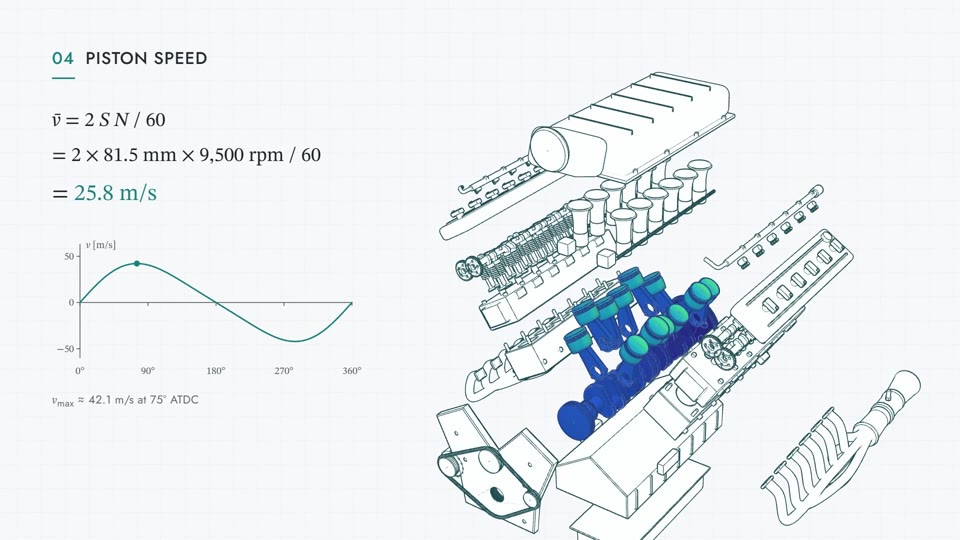
- 10 to 13.5 s, 04 PISTON SPEED. Banks fly apart sideways along their own axes; crank and pistons stay in the middle and spin up. Mean piston speed v̄ = 2SN/60 from [stroke] and [redline], a…
- 13.5 to 16.5 s, 05 INTAKE TUNING. Intake rises; trumpets and plenum go solid blue. f₁ = c / 4L from [runner length], with a decaying pressure-wave chart.
- 16 to 20 s, end. Reassembly, inner groups first, four snaps on eighth notes from 17.0 s. A rev blip spins the crank (peak 17.85 s) as one gradient sweep rises through the whole engine in…
The line-art look
- No lighting. Each piece renders three times: a near-white fill (#fcfdfd) with polygon offset; a back-face hull pushed out 1.6 px in clip space along screen-projected normals for a constant-width…
- Flow shader. Every vertex carries an aFlow coordinate (0 to 1 along the part: tube UVs, distance along the crank, piston height). Fill-front and drain-front uniforms sweep a band in…
- Line colour tints deep blue while a part flows, #164f9e while solid. [brand] sits on each cam cover as an outlined canvas-texture decal.
- Guard the GLSL: clamp inputs, guard divides, never reverse smoothstep edges.
What you can change
- A 120 BPM music bed with the downbeat on frame 0, soft clicks on every snap, servo whirs as parts separate, a distant engine blip…
How the prompt opens
Make a 20-second, 16:9 (1920x1080) motion piece at 60 fps, built in Three.js and driven by time alone. An invented V12 engine, drawn as thin dark-teal ink on white paper, never stops moving: it floats apart into an exploded view, snaps back together, stacks into a tower, splits its banks sideways, and reassembles for the end card. One subsystem at a time fills with a liquid gradient running from deep indigo through blue and cyan to mint (exhaust, then valve train, then pistons and crank), while a left-hand column works through the engineering maths with charts that draw themselves and numbers that count up. It closes on [your brand wordmark] and [your engine or product name]. The example uses an…
The full prompt runs 1,122 words. Copy it from this page.
Copy the prompt into Claude, or pull the scene into Claude Code and render the MP4 on your machine: how it works.