Mechanical watch teardown and reassembly
A mechanical watch teardown animation: the movement ticks, explodes into layers, then reassembles on the beat. Copy the prompt into Claude and render it free.
A 3D watch movement runs live: it ticks, is wound, explodes into layers while still running, then slows 200x inside the escapement. A panel shows why the seconds wheel turns once a minute, and the layers snap back together one per tick under a hook and call to action.
Change both hook lines, the maker name on the dial, the comment keyword, balance amplitude, accent, studio, brass and ink colours. At 9:16 and 28 seconds with mechanical sound, it suits watch education, engineering explainers and comment-for-the-prompt shorts.
Use it for
- Watch explainer short
- Engineering how-it-works video
- Comment-keyword lead magnet reel
Specs
- Length: 28 seconds
- Format: vertical 9:16 (1080x1920), 30 fps
- Built with: Three.js in HyperFrames
- Category: 3D
What happens, beat by beat
- 0-2.5 s, hook. A macro behind the escape wheel (15 mm away, 30 degree lens, elevation 47) on the dark plate: the entry ruby and the teeth around it sharp, everything else hidden. Each tooth landing…
- 2.5-7 s, the whole watch. Hard cut on a tick to a top view. Four corner chips slide in: BEAT RATE (five dots, one lit per beat), BALANCE (live sine trace), AMPLITUDE (gauge needle following beta)…
- 7-12.6 s, teardown. Slow three-quarter orbit, low elevation. Crystal, dial side, balance cock, bridges, balance and escapement, wheels and barrel lift in turn. A PARTS counter tallies up. Leader-line labels alternate sides, each part red while…
- 12.7-17.95 s, inside. Hard cut to the line of centres at 15 mm, pushing to 13. A red chip reads SLOWED 20x, then 200x. A giant phase word (LOCK, UNLOCK, IMPULSE, DROP) swaps on the model's…
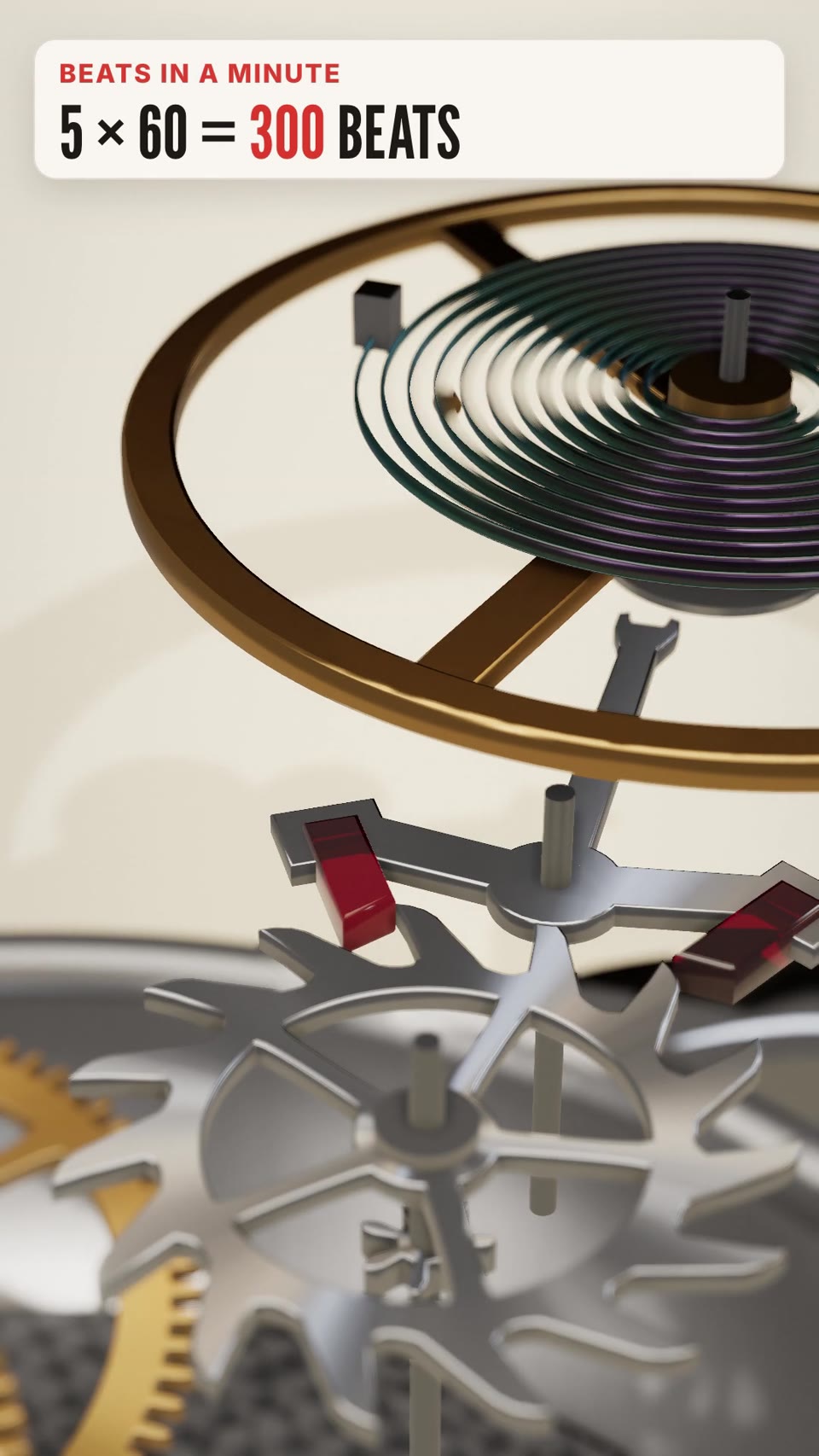
- 17.95-21.2 s, the maths. Three lines rise in already on their final number: 5 x 60 = 300 BEATS, 300 / 2 / 15 = 10 TURNS, 10 x 7 / 70 = 1 TURN A…
- 21.3-24.9 s, reassembly. Layers fall back bottom first, accelerating in and landing on every third tick with a tiny bounce, a 2.6 px jolt and a glint.
- 25.5-28 s, end. Watch crisp, no blur, 12 degree turntable and gentle push, red seconds hand ticking. CTA lines rise in, [your mascot or product shot] pops up below, then [your logo].
Materials and light
- Two baked environments from card scenes through PMREM: a bright warm studio for paint and stone, a darker one with hard tall strips for metal so every chamfer reads as…
- Procedural maps: radial graining on gilt wheels (anisotropy map), Geneva stripes on rhodium bridges (anisotropy direction plus a normal ripple across 2.1 mm bands), perlage spots on a dark ruthenium…
- Dial as a canvas texture: clearcoated ivory, serif numerals, railway track, brand name on an arc. The crystal is additive reflections only.
- Accent system: the part doing the work lerps toward the accent and glows from inside; on the escape wheel a shader masks just the working tooth.
- Studio: backdrop colour solved through an inverse ACES curve so it lands exactly on [your background colour]. Warm key from upper left with soft VSM shadows on an invisible floor…
How the prompt opens
Make a 28-second, 9:16 (1080x1920, 30 fps) motion piece with its own mechanical sound. A hand-wound watch movement in real 3D runs as a live simulation: it ticks, gets wound, explodes into layers while it keeps running, slows 200x inside the escapement, shows the maths of why the seconds wheel turns once a minute, then reassembles itself one layer per tick. It opens on [your hook, e.g. "NO BATTERY. / IT STILL KEEPS TIME."] and ends on [your call to action, e.g. "Comment / KEYWORD / for the prompt"]. The maker's name on the dial is an invented example (e.g. [a watchmaker called Odell & Vane]); swap in your own.
The full prompt runs 1,119 words. Copy it free (2 a day) from this page.
Copy the prompt into Claude, or pull the scene into Claude Code and render the MP4 on your machine: how it works.