MRI scanner explainer with spinning nuclei
A 40-second vertical MRI scanner explainer with spinning hydrogen nuclei and a brain built from slices. Copy it into Claude and edit the numbers.
A glossy black scanner sits on a dark seamless while thermal windows show the coils inside the cover. A paperclip twitches toward the magnet, the camera pushes into the bore and dives into a water drop, where hydrogen nuclei spin like chrome tops. It ends on a brain stacked from 26 slices.
Set the field strength in tesla and the headline, Earth multiple and megahertz readouts follow. Edit the coil temperature, scan loudness, screen headline and brand, and recolour the blocks, signal glow and backdrop. At 40 seconds in 9:16, it fits Reels, Shorts, patient information and imaging company explainers.
Use it for
- Patient education video on MRI
- Imaging company product explainer
- Science channel short on magnetism
Specs
- Length: 40 seconds
- Format: vertical 9:16 (1080x1920), 30 fps
- Built with: Three.js in HyperFrames
- Category: Explainers
What happens, beat by beat
- 0-1.5 ROOM. Slow 3/4 push on the scanner, table and a crystal head in the coil; a thermal window shows the coils inside the cover from frame 0.
- 1.5-3 HOOK. Floor-level macro: a paperclip twitches round to face the magnet (1.58 s), slides, and a whip-pan follows it onto the cover at 2.5 s: white flash, 3-frame shake.
- 3-6 BORE. Continuous push and slow roll into the bell mouth. A window wipes in on the coils with a [coil temperature, −269 °C] readout; headline [1.5] TESLA / [30,000]× EARTH'S FIELD.
- 6-7.5 DROP. Log push from 70 mm into a water drop on black glass (BODY WATER 0→60 %), zoom-blurring into the cut.
- 7.5-11 SPINS / FIELD. Tops tumble on random axes; at 10.5 s field lines draw down and every top snaps into line and precesses (FIELD 0→[1.50] T).
- 11-15 PULSE / RELAX. A golden ring expands from the centre; each top tips as it passes, glows, then relaxes back as the glow fades (RADIO PULSE 63.87 MHz).
- 15-18 RF COIL. The birdcage's copper rungs light in a rotating wave, then faint echoes; the brain glows inside the glass head.
- 18-22 LOUD. Cut-away magnet; the gradient coil knocks on a 16th-note pattern with shake and winding flashes, SOUND LEVEL → [110] dB, thermal split.
- 22-25.5 SLICES. Top-down on the head, each slab fires its own colour crown to stem (SLICE nn at its own MHz); 28 coloured stripes slide onto a screen and resolve into a greyscale slice.
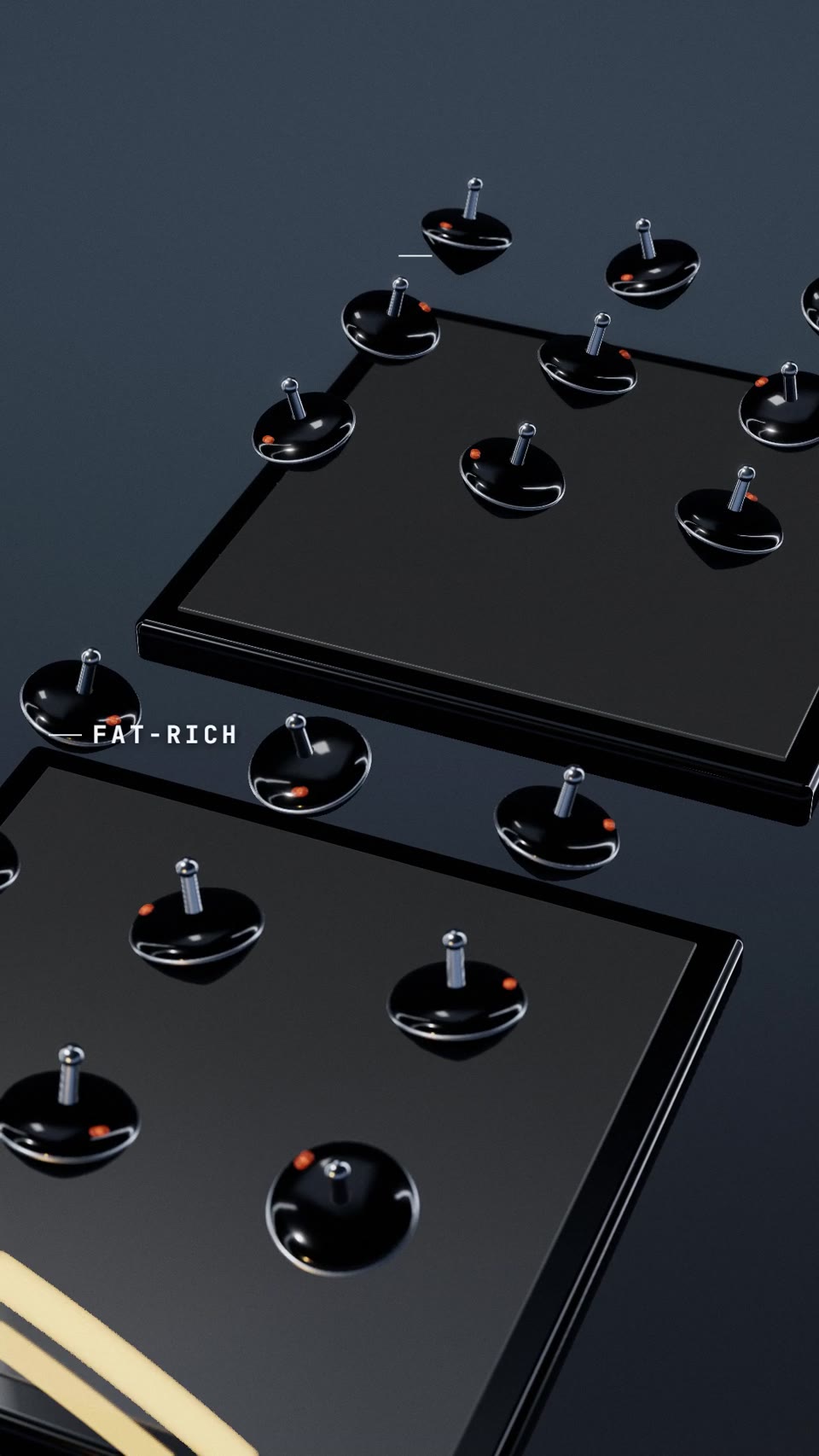
- 25.5-30 CONTRAST. Two tiles of tops, FAT-RICH and WATER-RICH. One ring tips both; the fat group snaps back and its tile goes light, the water group lags; a second ring at 27.6 s locks the greys.
Light, lens and finish
- A procedural jewellery-studio environment (near-black room, hard strips, hot top card) plus a soft box so black faces read as gradients; cool slate inside the water. One coloured rim per…
- Render linear and apply ACES in the composite; clear the glass's transmission buffer to the inverse-ACES of the seamless so the crystal head shows the studio.
- Gathered depth of field, adaptive motion blur (sub-frames from measured pixel motion), bloom, vignette, grain.
What you can change
- Composition variables: [field strength] (drives the tesla headline, Earth multiple and every MHz readout via 42.577 × T), [coil temperature], [screen headline], [brand], [loudness dB]…
- Render as a pure function of time from one paused GSAP timeline, seeded random only. Narrate one line per idea, mix music and effects to…
How the prompt opens
Make a 40-second, 9:16 (1080x1920, 30 fps) Three.js explainer of how an MRI scanner sees inside you, with narration, a 120 BPM music bed and recorded sound effects. A glossy black scanner on a dark seamless is read through flat "thermal camera" windows, the camera dives into a water drop where hydrogen nuclei are black-and-chrome spinning tops, and the film ends on a 3D brain stacked from 26 slices under [your brand, e.g. an imaging company called LUMA MR]. Swap in your own numbers, words and colours.
The full prompt runs 1,130 words. Copy it free (2 a day) from this page.
Copy the prompt into Claude, or pull the scene into Claude Code and render the MP4 on your machine: how it works.