Planet-sized telescope finds a black hole
Animated explainer of radio dishes linking across a night Earth until a black hole ring emerges from noise. Copy the prompt into Claude and edit it.
A night Earth turns slowly while the camera pushes in. Dishes light up one per beat, each with a rising beam, a ripple and a name pill, then glowing arcs link them into one planet-sized dish. Galaxy waves arrive, data is flown out, and a server hall folds noise into an orange ring.
Change the hook line, the captions for each stage, the source label by the galaxy, the six site names in light-up order and the ring colour. The 9:16 frame suits Shorts, Reels and TikTok, and works for science channels, course intros or any explainer about linking many sources.
Use it for
- Science channel Shorts explainer
- Astronomy course intro clip
- Observatory outreach social post
Specs
- Length: 40 seconds
- Format: vertical 9:16 (1080x1920), 30 fps
- Built with: Three.js in HyperFrames
- Category: Explainers
What happens, beat by beat
- 0-3.5 s. Earth already on screen, camera orbiting over the night Pacific and pushing in. Hook at 0.2 s: [e.g. "How eight telescopes became one the size of Earth"].
- 3.5-7 s. One site per beat: a bright point, a thin beam rising with a back-out overshoot, a ripple ring and a pill label from [six site names], gone after about 1.5 s. Camera orbits east…
- 8-11.5 s. Fifteen great-circle links draw on, one starting every eighth of a beat. Camera rises onto the source axis so the Earth is face-on; panel rings and seams spread across the globe, a rim of…
- 12.3-16.6 s. Camera swings 82 degrees to a side view, tilts up to the galaxy (fov 30 to 12, only once it is in frame), label [source name], wave rings leave it on each beat, then…
- 16.5-20.5 s. Wavefront wipe to a 12 m dish on a night plateau under the Milky Way. Wave sheets land in the bowl on each beat, the panel seams flash, ticks run down a cable to…
- 20.1-24.5 s. Circle match from the bowl back to the Earth-dish. Eight cream flight trails arc to two glowing destinations, two per beat; camera dives at one. Caption [e.g. "Petabytes, flown on hard drives"].
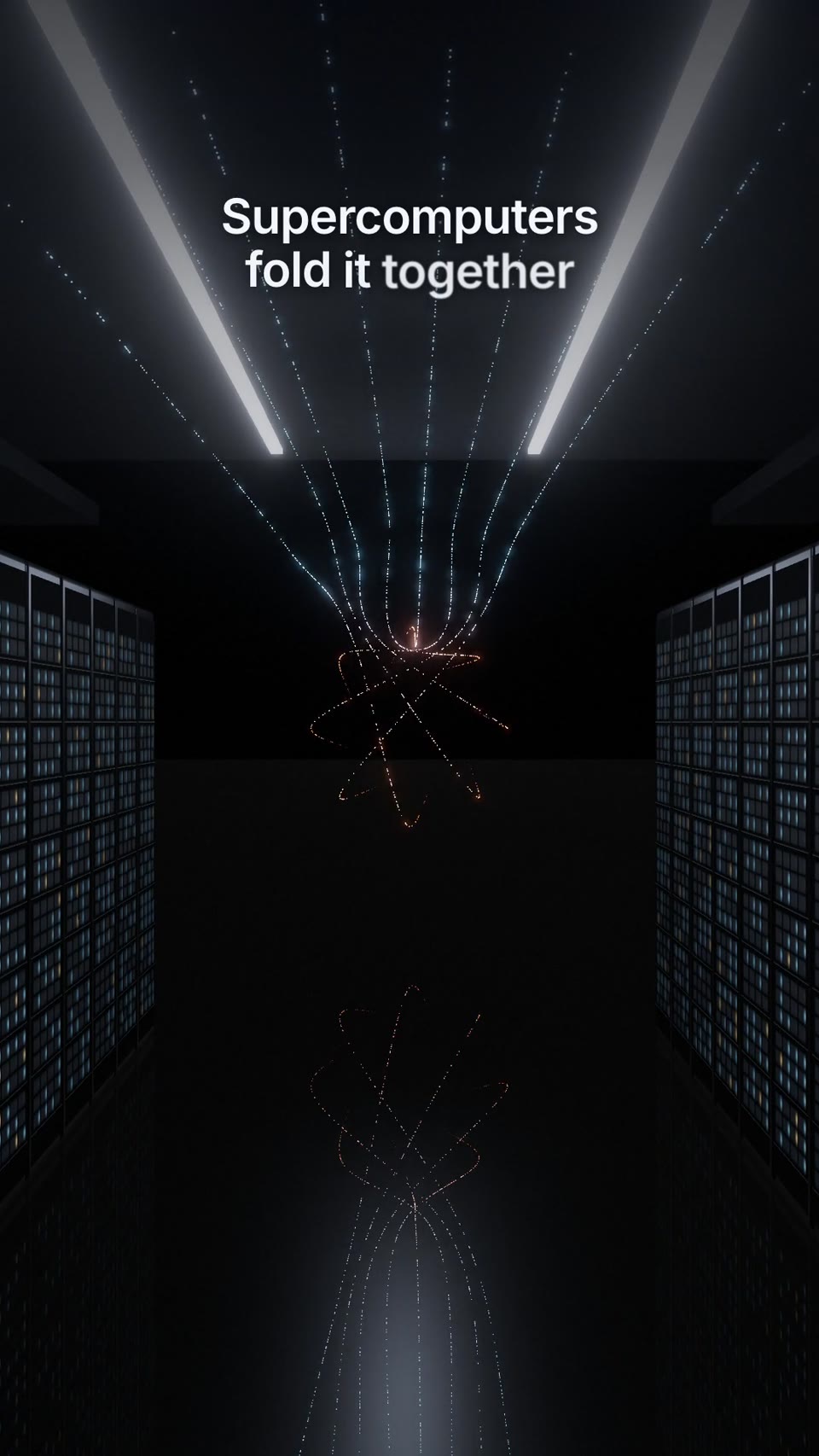
- 24.5-28 s. Iris out of that glow into a dark hall; fly down an aisle of drive racks at about 4 m/s under streams of blue data. Caption [e.g. "Supercomputers fold it together"].
- 28-33 s. Noise folds into a lopsided ring, sharpens and crossfades into the real image. Caption [e.g. "About 6.5 billion times the Sun's mass"].
- 34.5-40 s. White particles break back towards noise over the image (dimmed to half, never gone), rebuild the same ring, and a white contour draws round it. Caption [e.g. "2026: a new method rebuilt the same…
Transitions, post, type, sound
- A composite pass does three motivated transitions: a wobbling wavefront wipe with a glowing edge, a crossfade on the matched circle, and an iris from the projected destination point. MSAA…
- Captions: Inter 600, 64 px, centred near the top over a soft scrim, one line at a time; words blur-rise in on a 0.07 s stagger and the line lifts…
- Sound: narration on the beats, music ducked under it, real recorded clicks, whooshes, ticks, a jet, server hum and a chime as the contour lands; -14 LUFS.
How the prompt opens
Make a 40-second, 9:16 (1080x1920, 30 fps) Three.js explainer with narration, a music bed and real recorded sound effects. Radio dishes light up at their real sites on a slowly turning night Earth, glowing arcs link them and the planet itself turns into a dish. Faint waves from a distant galaxy reach it, one dish catches them, the recordings are flown to supercomputers, and in a server hall the data folds out of noise into a glowing orange ring that crossfades into [your real result image]. Swap in [your subject: sites, source, numbers and captions], e.g. eight observatories from Hawaii to the South Pole watching the galaxy M87.
The full prompt runs 1,109 words. Copy it from this page.
Copy the prompt into Claude, or pull the scene into Claude Code and render the MP4 on your machine: how it works.