Pro zoom lens cutaway
Animated camera lens cutaway: rays refract through the glass, aperture blades close, parts line up. Copy the prompt into Claude and make your own.
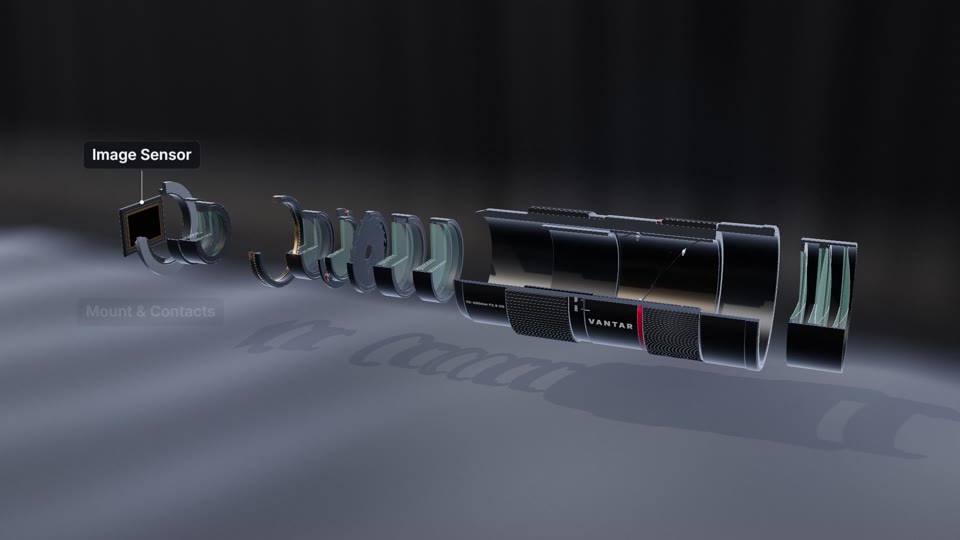
A black zoom lens turns over black satin while two seams of light trace its side and a quarter of the barrel lifts away. Red, green and blue rays pass through each glass element and meet at one point on the sensor. Nine aperture blades then close with a live readout, and the lens separates into labelled parts before sliding back together.
Change the lens maker, model, opening and closing lines, the light-beat caption, both aperture values, the ring stripe and accent colour, and the satin backdrop. It suits camera brand launches, photography course intros and product explainers on YouTube or a landing page, in 16:9 with no sound to sync.
Use it for
- Camera brand launch film
- Photography course intro
- Lens explainer for a product page
Specs
- Length: 20 seconds
- Format: widescreen 16:9 (1920x1080), 30 fps
- Built with: Three.js in HyperFrames
- Category: 3D
What happens, beat by beat
- 0-3.4 s, hero. Close front three-quarter on the coated front glass, pulling back until the whole lens fits (by 1.5 s), then rising. The lens yaws into place while the environment counter-rotates, so reflections slide along…
- 3.15-4.3 s, seams. Two hairlines of warm light run front to mount along the two cut planes, each with a hot glowing head.
- 4.3-5.2 s, cut. The top-front quarter hops free (short ease-out), then accelerates up out of frame. The sensor slides in behind the mount.
- 5.2-9.0 s, light. Camera square on to the vertical cut face. A fan of 7 RGB ray triplets travels in, kinks at every surface and lands on one point. Caption [one line about the optics], 6.1-8.9…
- 9.0-11.2 s, aperture. Down the axis. Glass in front of the iris ghosts clear, blades close, an all-round ray set passes the opening and blocked rays end on the blades in sparks. Readout card: "APERTURE", a…
- 11.1-15.8 s, explode. One continuous pull-out while parts slide apart with a soft overshoot. Eight labels arrive 0.24 s apart, hold 1.42 s each, leave.
- 15.75-16.75 s, reassemble. Parts slide home with a tiny damped settle, iris reopens, camera swings to the sensor.
- 16.75-18.45 s, picture. Rays return, the pinpoint glows, then gives way as the die develops [your picture] turned 180 degrees.
- 17.9-20 s, close. Pull back to a three-quarter hero of the closed lens; the sensor eases back and turns to show its picture. Lockup from 18.1 s: [BRAND], accent rule, [tagline, e.g. "Every ray, one point."].
Glass, light and rays
- Glass as reflection only: premultiplied, about 4% body, low reflectance per surface so 34 surfaces never stack to milk, iridescence for magenta and green coating sheen, a cool Fresnel rim.…
- Sawn faces glow only where light crosses: splat every ray into an (x, r) density texture and add it as glow on the faint cyan-green caps and nearby metal. A…
- Rays as screen-space ribbons in an additive pass: depth-tested against the scene, widened by circle of confusion, a travelling bright head, a glint at each surface, thinning into the focus…
- Iris: nine thin bevelled crescent blades on pivots, alternating tone, hidden past the housing radius. Precompute blade angle against opening radius and drive it from EV.
- Sensor: black ceramic package, gold frame and bond pads, dark iridescent mirror die. The picture develops as a growing ellipse whose edge flashes a red-green-blue Bayer pattern.
How the prompt opens
Make a silent 20-second, 16:9 (1920x1080, 30 fps) Three.js product film. A black pro zoom lens turns over black satin, two seams of light trace its flank and a quarter of the barrel lifts away. Red, green and blue rays refract through every glass element, split by colour mid-lens and rejoin at one pinpoint on an image sensor. Head-on, nine aperture blades close from [f/2.8] to [f/11] with a live readout. The lens comes apart into an evenly spaced line of labelled parts, slides back together, and the sensor develops a picture upside down, as a real lens projects it. The maker is an invented example (e.g. a lens brand called "Vantar"): swap in [your brand], [your model, e.g. 70-200mm…
The full prompt runs 1,106 words. Copy it free (2 a day) from this page.
Copy the prompt into Claude, or pull the scene into Claude Code and render the MP4 on your machine: how it works.