Quantum computer thermal dive
Quantum computer animation in 9:16: a thermal camera dives down a gold cryostat to one glowing qubit. Copy the prompt into Claude and edit it.
A gold dilution refrigerator hangs in a dark studio while thermal-camera windows slam over it on the beat, white-hot at the top and navy at the base. The camera descends plate by plate with a live kelvin counter, dives into the chip, and shows a qubit as a Bloch sphere at 0, 1, then both.
Change the hook headline, qubit line, closing line and brand, plus the plating, qubit, excited and thermal colours and the studio backdrop. The 9:16 frame suits Reels, TikTok and Shorts, and 16 seconds is enough for a product teaser or a quick explainer on how qubits work.
Use it for
- Quantum startup launch teaser
- Qubits explained for social
- Deep-tech investor pitch intro
Specs
- Length: 16 seconds
- Format: vertical 9:16 (1080x1920), 30 fps
- Built with: Three.js in HyperFrames
- Category: Explainers
What happens, beat by beat
- 0-1 s, hook. Low three-quarter macro under the bottom plate, looking up the gold stack, pushing in. An ice window slams in from the right at 0.1 s. Top-left HUD: "MIXING CHAMBER", a huge [0.010] K…
- 1-2 s. The whole chandelier, slow turn. A window fitted to the chandelier's projected bounds wipes left to right, turning gold into thermal live: hot top, cold bottom. [COLDER THAN SPACE] at the top.
- 2-5 s, descent. Three one-second shots past the 50 K plate, the 4 K plate and the still, each from outside the rim on a long lens at the same downward speed, alternating sides. A window…
- 5-6 s. Over the open gold chip package, then an exponential (log-distance) zoom from 26 to 2 cm onto the chip; a small window opens on the package; counter 0.9 to 0.010 K.
- 6-7.5 s, qubit. Micro world: a Bloch sphere grows out of one cross-shaped qubit, arrow at 0, HUD bars "0 100% / 1 0%". At 7.0 s the arrow flips to 1 with an overshoot, turns…
- 7.5-10 s. Low against the chip's mirror reflections: the arrow tips to the equator and spins, bars 50/50. [A QUBIT IS / 0 AND 1 AT ONCE] at the bottom over a scrim. At 9.0 s…
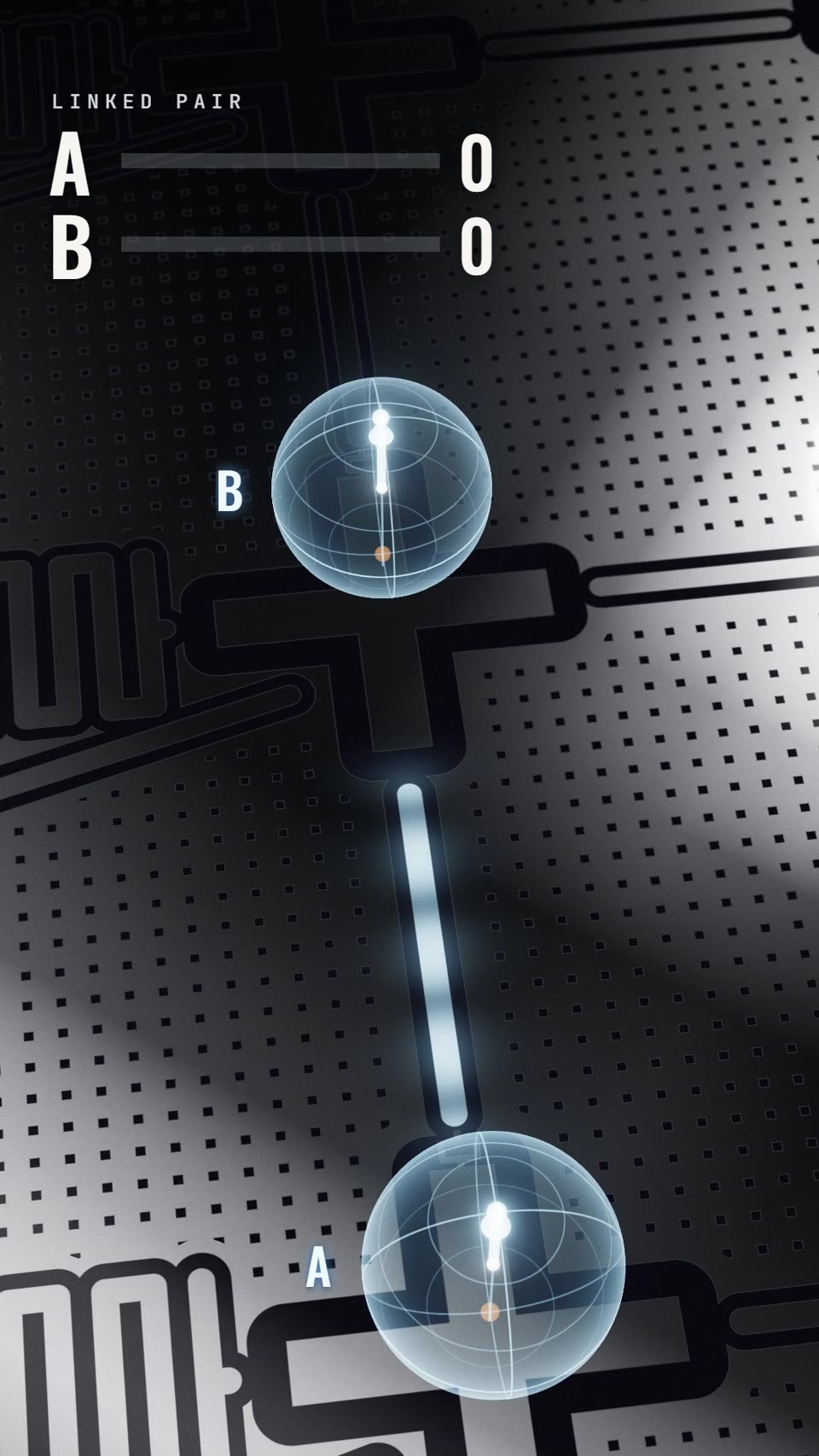
- 10-11.5 s, link. Two coupled qubits, A and B. The coupler glows, a drive pulse runs to A, and at 10.9 s both flip on the same frame, amber, each with a "HOT" window.
- 11.5-13 s, register. Top-down on the 2x4 chip, pulling back as qubits light in pairs from the centre out, 0.24 s apart. "STATES AT ONCE" doubles 2 to [256]. At 12.5 s one window covers all…
- 13-14.5 s, out. The register shrinks into the gold package under the bottom plate, then a log pull-out to the whole chandelier. [ONE ANSWER FROM EVERY PATH] over clean dark space.
- 14.5-16 s, hero. The chandelier turns about 30 degrees and rises. A white-hot band of light climbs from the chip to the top flange in 0.6 s; as it lands (15.27 s) [QORE] scales from 1.14…
Light, lens and finish
- Procedural PMREM studio: near-black room, hard thin strip lights, a hot top card, soft side cards so plate tops read polished gold. One key light. Metal roughness 0.15 to 0.21.
- Exterior background: near-black, deep-navy falloff behind the hero, faint stars, fbm cold vapour pooling off the bottom stage. The micro world gets a dimmer environment and slate fog.
- 4x MSAA half-float targets, adaptive accumulation motion blur, gather depth of field, low bloom with highlights clamped so gold never blows white, ACES, vignette, film grain.
- Bloch spheres are additive light in their own depth-tested pass: fresnel shell, equator, meridians, ice bead at 0, amber bead at 1. Superposition adds a banded cold/hot sweep trailing the…
How the prompt opens
Make a 16-second, 9:16 (1080x1920), 30 fps explainer in Three.js. A glossy gold dilution-refrigerator "chandelier" hangs in a near-black studio while thermal-camera windows slam over it on the beat, re-colouring it white-hot at the top and deep navy at the base. The camera descends plate by plate with a live kelvin counter, dives into the chip, shows a qubit as a glowing Bloch sphere at 0, at 1, then both at once, links two qubits, lights a register of eight, and pulls back out to the whole chandelier as [your brand, e.g. an invented quantum company called QORE] lands. Swap in your own lines, numbers and colours.
The full prompt runs 1,115 words. Copy it free (2 a day) from this page.
Copy the prompt into Claude, or pull the scene into Claude Code and render the MP4 on your machine: how it works.