Turbofan assembly with thermal windows
A turbofan assembly animation in 9:16: one titanium blade becomes a running jet engine under thermal-camera windows. Copy the prompt into Claude and edit it.
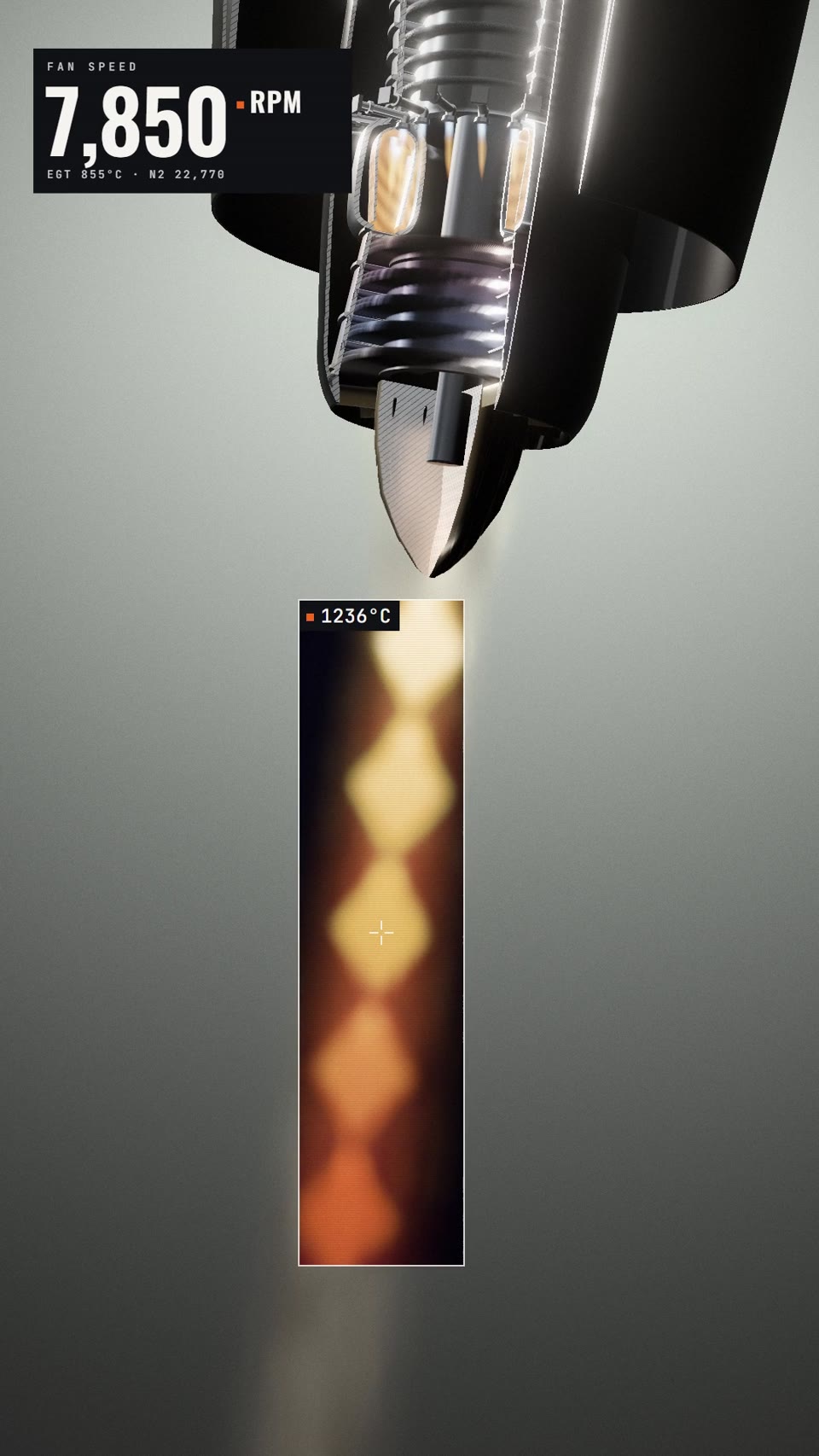
A single mirror-titanium fan blade turns under a strip light, then the full engine assembles in fast cuts. A quarter-section opens it like a museum cutaway, and it spools up while thermal windows slide across: cold blue intake, orange combustor, white-hot jet.
Change the hook headline, brand name, top fan speed in rpm and blade count, then recolour the warm, cool and amber thermal tones and the studio backdrop. The tall 1080x1920 frame suits Reels, TikTok and Shorts, plus aerospace product teasers and engineering explainers.
Use it for
- Aerospace brand teaser reel
- Engineering explainer for Shorts
- Jet engine product launch clip
Specs
- Length: 15 seconds
- Format: vertical 9:16 (1080x1920), 30 fps
- Built with: Three.js in HyperFrames
- Category: 3D
What happens, beat by beat
- 0.0-1.0 Hook. Macro on the blade tip, the highlight running along its twist. [Headline: ONE BLADE.] rises out of a mask at 0.21 (0.1 s, expo out) and leaves upward at 1.64. Keep the blade clear…
- 1.0-2.0 Whole blade, span vertical, turning about 30 degrees so the twist reads.
- 2.0-2.5 Slot. Rim macro: the dovetail root drops into its disk slot with a small overshoot and a shake at 2.30.
- 2.5-3.1 Ring. The other [22] blades shoot in round the disk over 0.4 s; the spinner lands at 3.04 with a bigger shake.
- 3.1-3.6 Side view, rolled diagonal: 3 booster and 7 compressor stages slide in from the rear, about 0.04 s apart.
- 3.6-4.1 Low macro: combustor liner with 18 fuel injectors, then 1 high-pressure and 4 low-pressure turbine stages lock.
- 4.1-4.7 Wide: casing halves clamshell shut at 4.30, core cowl 4.42, nacelle 4.54, then the plug. Shake on each.
- 4.7-6.0 Section. A quarter wedge is cut away, sweeping intake to plug from 4.88 to 5.38 with a glowing orange edge that then cools.
- 6.0-7.0 Compressor. Spool starts at 6.15. A black HUD card slides in from the left ("FAN SPEED", big counter, small "EGT / N2" line). Airflow streaks start.
- 7.0-8.0 Combustor. Light-off at 7.20: 18 flame tongues ignite with a 2.6x overshoot, a bloom lift and a shake.
Section cut, light and materials
- Cutaway: three clipping planes (two radial, one sweeping axial). Draw section caps in the shader: on back faces, find where the view ray leaves the removed wedge and shade that…
- Studio: environment maps from a shader sphere through PMREM: near-black room, two hard vertical strips, a hot top card and a long strip along the engine axis; a softer-gradient env…
- Materials: gloss black oxide cowls (#1D1E21, metalness 0.85, roughness 0.16, clearcoat 1); mirror titanium fan (roughness 0.15); heat-tinted turbine parts (bronze, purple, blue, straw down the plug); effusion holes on…
- Backdrop: soft grey seamless [backdrop colour] drawn in the composite, with a lit pool following the subject and a vignette.
How the prompt opens
Make a silent 15-second, 9:16 (1080x1920, 30 fps) product film in Three.js. A single mirror-titanium fan blade turns under a strip light. A whole high-bypass turbofan then assembles in fast cuts, a quarter-section opens it like a museum cutaway, and it spools up while thermal-camera windows slide over the frame to show the air: cold blue at the intake, an orange combustor, a white-hot jet with shock diamonds. A live counter climbs to [your top number: 10,000 RPM] and the film ends on [your brand, e.g. an invented engine maker called AERIS T7]. Swap in your own words, numbers and colours.
The full prompt runs 1,119 words. Copy it free (2 a day) from this page.
Copy the prompt into Claude, or pull the scene into Claude Code and render the MP4 on your machine: how it works.