X-ray battery charge dive
An X-ray battery animation: a loupe opens on a glossy cell, dives inside to glowing ions and a 0 to 100 charge counter. Copy the prompt into Claude.
A black cell stands in a dark studio while a circular X-ray loupe shows the glowing coil inside. The camera dives into a microscopic world where ions pour across a separator in a river of light, a counter runs 0 to 100% with flat temperature, then it pulls back to a lit ring and the brand.
Edit the headline, brand, held temperature, ion light, thermal hot, cold and amber colours, and the studio backdrop. At 9:16 and 14 seconds with sound, it fits battery, charger and EV product ads on Reels, TikTok and Shorts.
Use it for
- Battery product launch ad
- Fast-charging explainer short
- EV tech vertical teaser
Specs
- Length: 14 seconds
- Format: vertical 9:16 (1080x1920), 30 fps
- Built with: Three.js in HyperFrames
- Category: 3D
What happens, beat by beat
- 0.0-1.0 Hook. Three-quarter view, slow push in, cell about 70% of frame height. The loupe is already open on frame 0, tracking the can: inside it, an X-ray of the jelly roll with a scan line…
- 1.0-2.0 Top. Cut high onto the cell's top. The loupe re-sweeps onto it; the studio fades to deep slate (1.6-1.95 s) and the loupe grows to fill the frame.
- 2.0-3.0 Dive. Straight down onto the coiled top, log zoom from 60 mm to 3.6 mm with the roll unwinding a quarter turn, ending between two sheets.
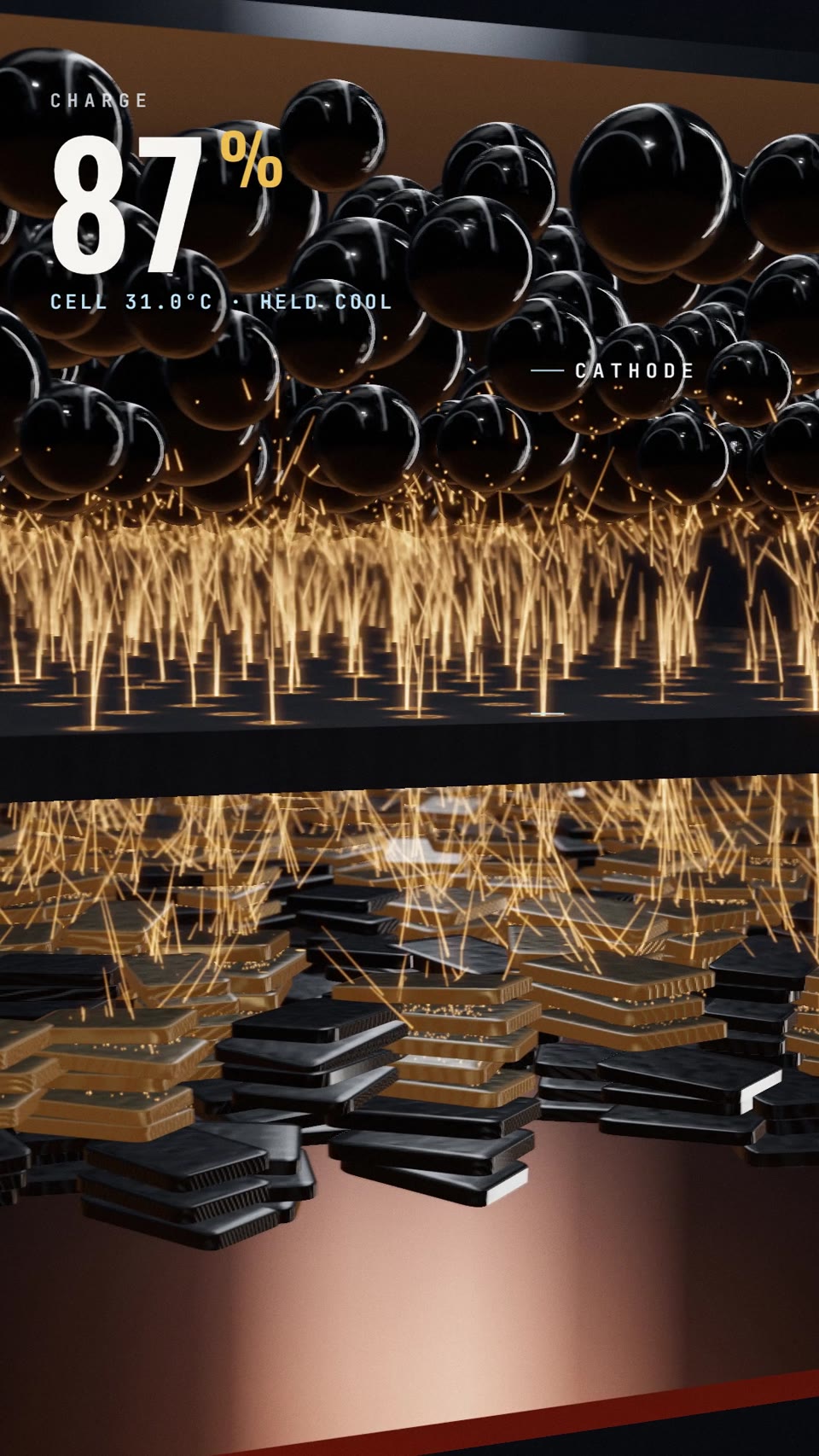
- 3.0-4.0 Wait. Inside: a ceiling of glossy black spheres, a membrane, a floor of graphite flakes. Rack focus from ceiling to pores; the waiting ions brighten and twitch at 3.75. Headline [SIX SECONDS.] rises into a…
- 4.0-5.5 Charge. Release on the cut. The counter (CHARGE, huge %, with [CELL 31.0°C · HELD COOL] as one small line under it) slides in.
- 5.5-7.0 Pore. Low lateral slide over the membrane, one hero pore held near centre; a second loupe sweeps in as nine bright hero ions spiral through it.
- 7.0-8.5 Anode. Lower corridor. A third loupe over one stack of flakes as they turn dark gold, with landing sparks timed to the real arrivals.
- 8.5-11.0 Slice. Slow 2.5 s lateral track across the whole stack in section. CATHODE / SEPARATOR / ANODE labels wipe on, pinned to their layers, clear before the cut.
- 11.0-14.0 Out. Close on the top, pull back to the hero cell. At 11.4 the ring completes: double pulse, bloom and exposure flash, "100" in the display, counter jumps to 100 and leaves. [Brand] rises at…
Build the micro world
- Cathode ceiling: about 2,600 glossy black spheres, dart-thrown with no overlaps, clearcoated, with a noise bump so each catches crisp strip highlights.
- Separator: a smoky dark film. Pores come from a shared hash grid (identical in JS and GLSL), discarded holes with a thin glowing rim and short instanced tubes.
- Anode floor: "books" of rounded-box graphite flakes with striated sides. Each flake gets the first and last landing time of its ions as an attribute, so it lithiates to dark…
- Ions: 36,000 analytic streak sprites, a pure function of time. Each spirals down into its pore (a small whirlpool), passes through and swirls out to a flake. Departures follow a…
How the prompt opens
Make a 14-second, 9:16 (1080x1920, 30 fps) product film with sound. A glossy black cylindrical battery cell stands in a dark studio. A circular X-ray loupe opens over it and shows the coiled layers inside, glowing amber. The camera dives into the top of the coil and down into a microscopic world, where thousands of glowing ions wait, then pour across a separator membrane in a river of light. A big counter runs 0 to 100% while the temperature stays flat. Then we pull back out to the solid cell: a ring of light round its top completes with a contact click, a "100" lights under the glass, and [your brand, e.g. an invented battery brand called VOLTA CELL] rises…
The full prompt runs 1,101 words. Copy it free (2 a day) from this page.
Copy the prompt into Claude, or pull the scene into Claude Code and render the MP4 on your machine: how it works.